
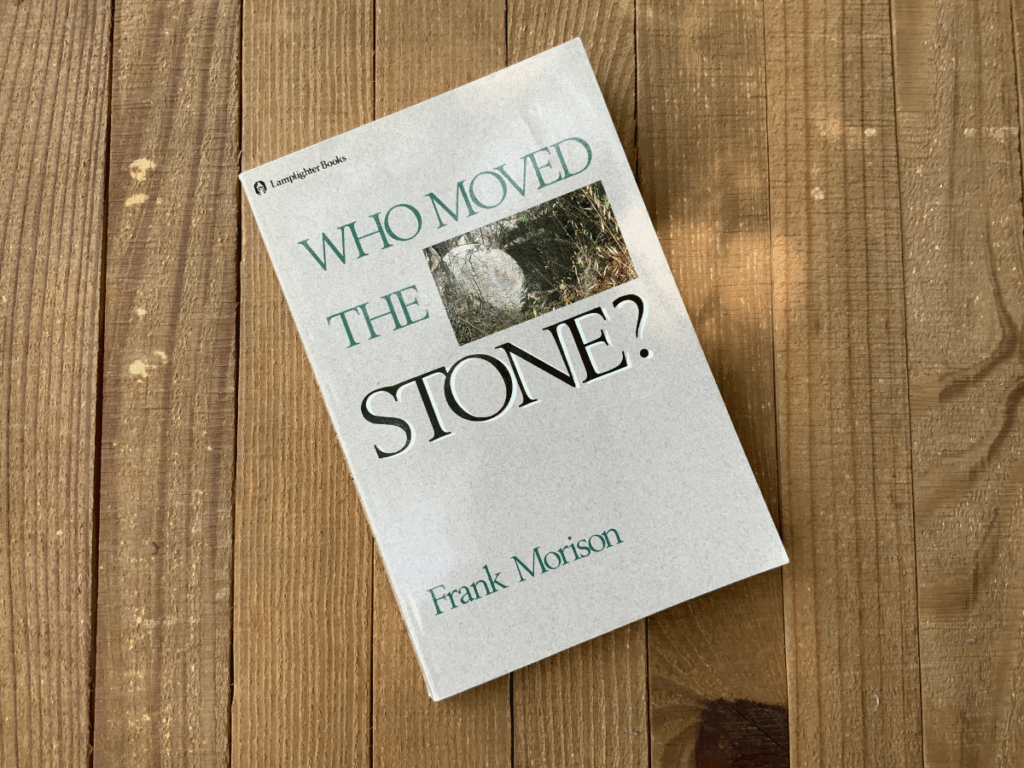

WHY DO I RECOMMEND THIS BOOK? The Resurrection is central to the believer’s life in Christ. And when I find a book whose compelling journalism illuminates and pieces together the events of the week leading up to Calvary, I MUST share.
Early in Morison’s narrative, we learn of his desire to explore the motives of the parties involved, essentially to prove the veracity of the Biblical accounts. There are the contentious religious parties in power, the Romans, the rulers, the Jews, the Disciples, our Lord, and numerous other characters whose time spent on stage may appear insignificant at times but who later in the book develop as key witnesses.
A Journalist’s Journey to the Truth of the Resurrection
Mending together the events surrounding Calvary into a chronological discussion helps Morison’s postmortem, and that dramatic last week’s events are central to his mission.
Legal and cultural insights abound, along with character studies brought out from scripture and historical accounts alike — all from an English journalist who wrote this about 1930.
Yet it reads like a thriller. I won’t spoil the conclusion, but I will say that the discussion and theories put forth do weave together nicely, especially with unnamed and mysterious characters.
Table of Contents:
Preface
1. The Book That Refused to be Written 9
2. The Real Case Against the Prisoner 13
3. What Happened Before Midnight on Thursday 30
4. A Psychological Parallelogram of Forces 43
5. The Situation on Friday Afternoon 60
6. Thirty-Six Hours Later 68
7. On the Behavior of Two Sisters and the Men Who Fled in the Night 79
8. Between Sunset and Dawn 88
9. The Historic Crux of the Problem 104
10. The Evidence of the Principal Fisherman 118
11. The Evidence of the Prisoner’s Brother 126
12. The Evidence of the Man From Tarsus 133
13. The Witness of the Great Stone 146
14. Some Realities of That Far-Off Morning 167
15. The Servant of the Priest 188
Unfolding the Final Week — A Gripping, Fact-Based Look at Calvary
The blessing of Morison’s work is you can see by his thought-provoking questions, and subsequent analysis, that he has prayerfully pondered numerous angles and been enlightened by the Holy Spirit with the fruit of that endeavor. As one who has read the gospel accounts numerous times, I was blessed by Morison’s explorations with a sense of discovery.
As a believer, I appreciate any writer who reaches out to historical antiquity to corroborate the accounts from the Bible. Morison is one of those gifted scribes who looks to Josephus and Philo, among others, in collating customs, legalities and the environment surrounding the brute drama of Christ’s last week leading up to Calvary.
At a deeper level, Morison sufficiently exposes underlying subtleties that give dimensionality and structure to the motives of many characters on the Calvary stage. His reconstruction is remarkable, in fact, to the point of compelling evidence that requires further thought. His study on Pilate, a character thrown into the center of this mock trial, is profound.
Other character studies emerge throughout: James, the brother of Christ; Saul of Tarsus; the two sisters.
And the scene of the empty tomb! — a life-changing account in its own right — found in the portrait Morison paints illuminates many here-to-fore ambiguities.
Related Books on Strong Christian Foundations:
Where to begin study: Major Bible Themes, by Lewis Chafer
Preparing to give answer as a growing Christian: Why I Believe, by Chip Ingram
This review was part of my 9 Lifelong Bible Companions Series. See related recommendations.
Rabbit hole: Piecing together the Gospel accounts of the week leading up to Calvary — in chronological order — is no small chore. But I have found a two-part video series from Bro Chuck Missler who does a pretty good job.
Who Moved the Stone?, by Frank Morison